Social & Political Philosophy
Times & Locations
| Start Date | End Date | Days | Time | Location |
|---|---|---|---|---|
| 1/26/2027 | 5/10/2027 | TR | 9:40am - 11:00am | HS 107 |
Additional Course Details:
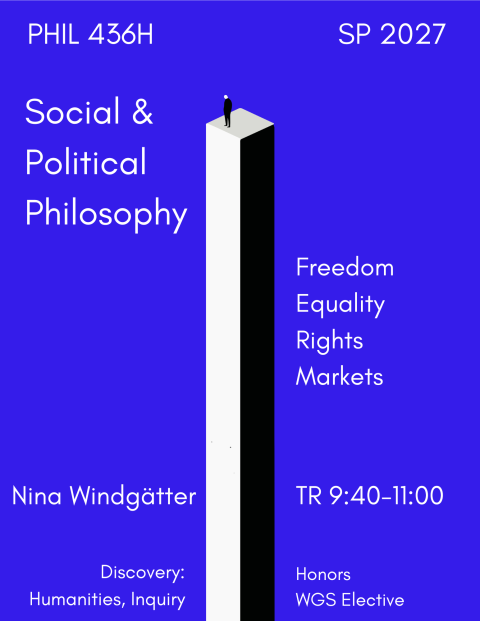
What does it mean to live in a just society, and what do we owe one another when basic needs are on the line? This course interrogates the core pillars of political life—freedom, equality, rights, and the proper reach of markets—by putting three major traditions into direct debate: Classical Liberalism, High Liberalism, and Socialism. As this is an approved Women and Gender Studies elective, we will pay particular attention to how gendered disparities and the institution of the family complicate these theories, asking whether traditional conceptions of liberty and justice adequately protect women from private domination at work or in the home.
To encourage close reading, sustained focus, and active class discussion, this is an unplugged course: all students are required to purchase physical copies of the assigned texts and bring them to every class meeting, reading with pen in hand.
- Mill, John Stuart. On Liberty
- Mill, John Stuart. On the Subjection of Women
- Friedman, Milton. Capitalism and Freedom
- Rawls, John. Justice as Fairness: A Restatement
- Okin, Susan Moller. Justice, Gender, and the Family
- Pettit, Philip. Just Freedom
- Cohen, G.A. Why Not Socialism?
